
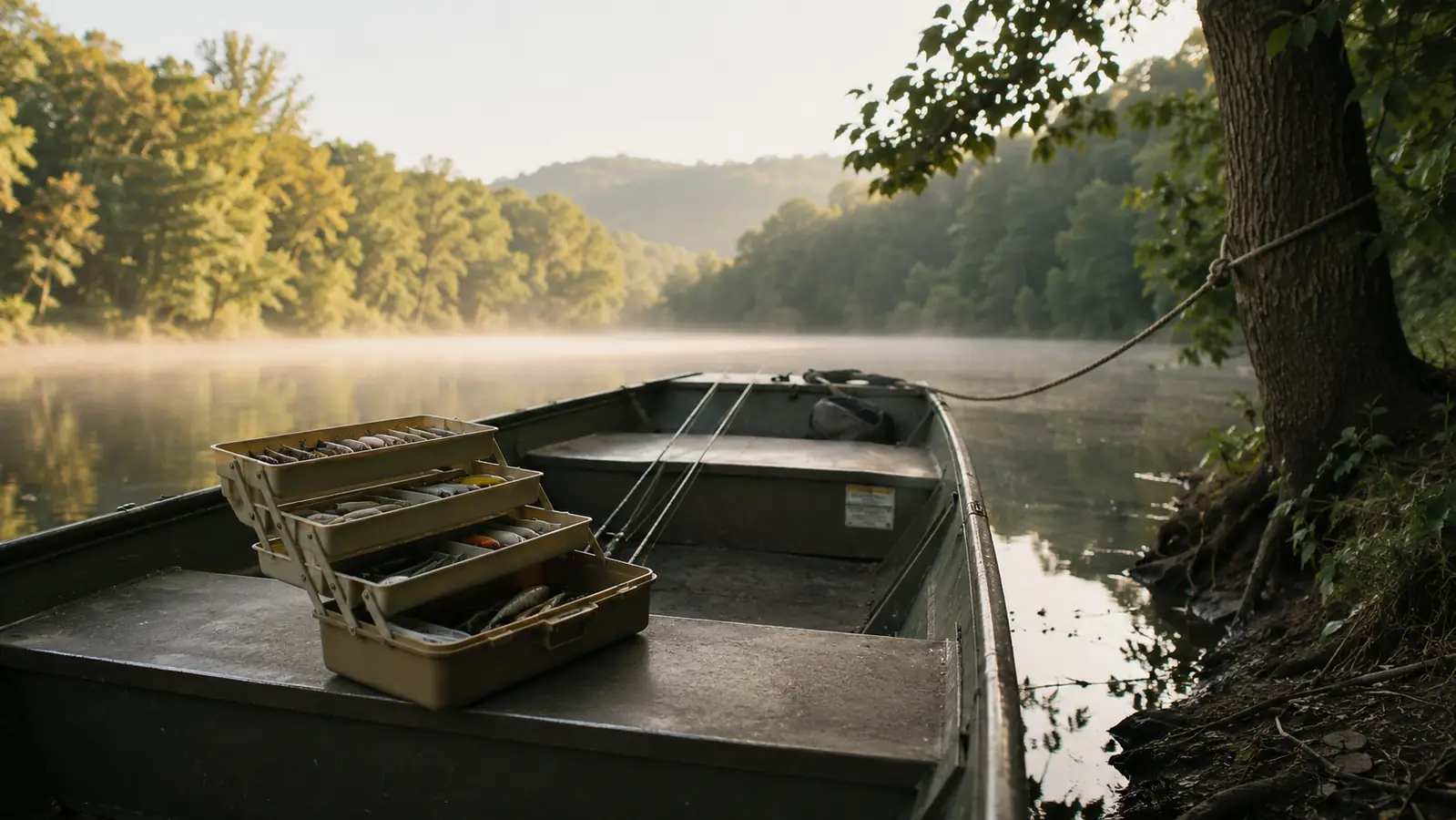
I lost a 4-pound smallmouth on the Current River last spring because I could not get to the right lure in time. He was sitting on a gravel bar, the bite was on, and I was wrist-deep in a tangle of spinnerbaits, hookless jigs, and two soft plastic worms that had melted into one sad blob in the heat. By the time I untangled the one thing I actually wanted, the fish was gone. That was the afternoon I got honest with myself. My tackle was a mess, and the mess was costing me fish.
I have tried every cheap fix over the years. A ziploc bag full of hooks that turned into a chain link fence of treble hooks. A flat plastic tray that dumped its whole load every time I carried it by the handle. I even fished out of a bucket for a while, which worked until I needed one specific jig head and had to upend the whole thing on the boat deck. So when I picked up a Plano three-tray tackle box last spring, I was not expecting much. A season of bounces in a truck bed and on a boat deck later, I am the one who was wrong. It is not perfect and I will tell you where it falls short, but it ended the dig.
The Quick Verdict
The box that finally ended the dig. Three trays that hold a season of tackle, a brass latch that still clicks clean, and one honest quirk about the top tray.
Amazon Check Today's Price →The box I stopped digging through by the second trip
If your tackle is a tangle and you have lost one more fish to a messy box, this is the one I would start with. It has bounced in my truck bed and sat on my boat deck all season. Check today's price on Amazon.
Amazon Check Today's Price on Amazon →How I've Used It
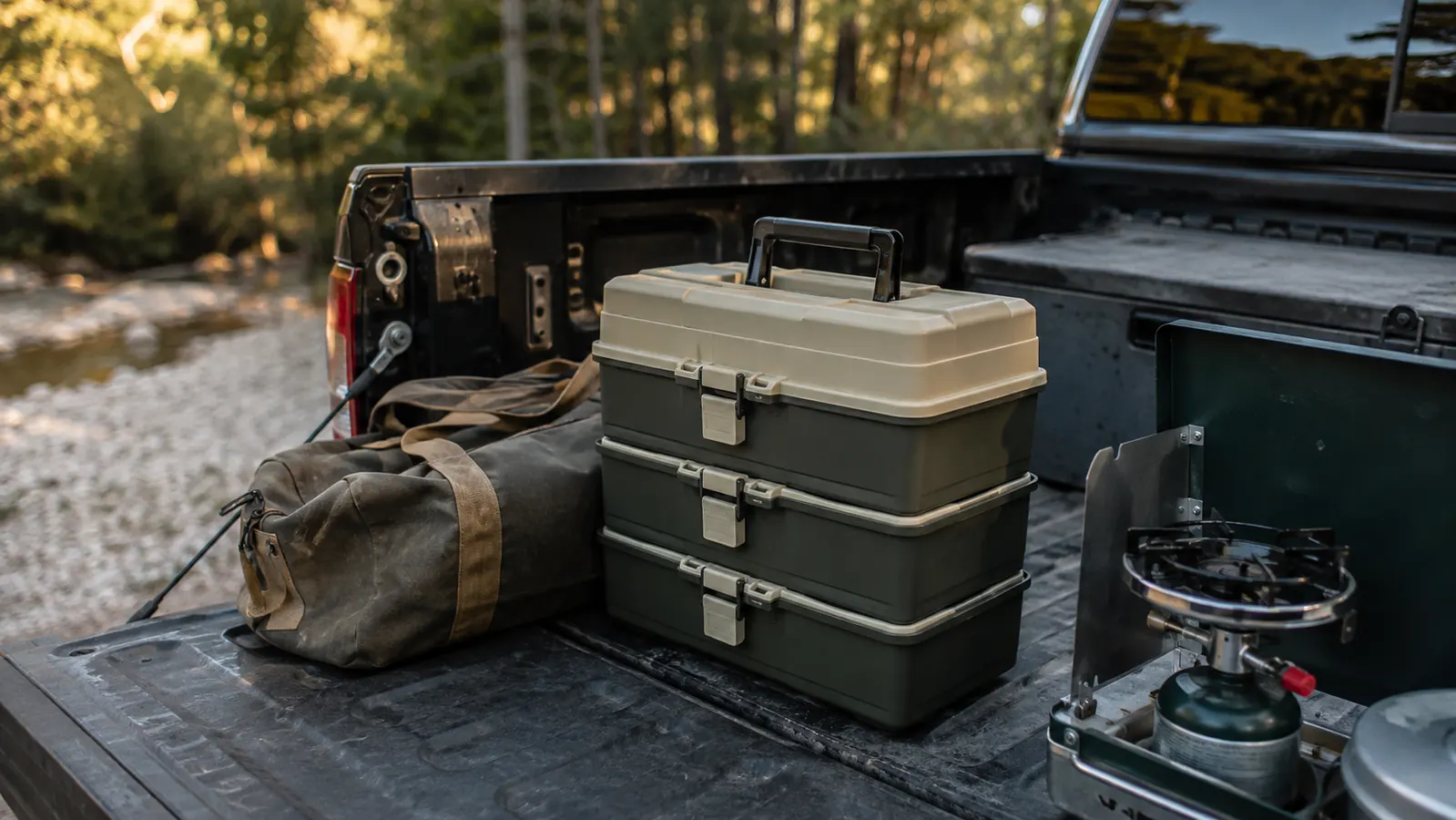
Let me be clear about the test. I did not set this box on a shelf and open it twice for a clean, catalog-style review. It has ridden in the back of my truck under a load of camping gear, bounced down gravel roads in the four-wheeler box, and sat on the deck of my flat-bottom boat through a hundred-degree afternoon. It went out in the rain, it sat in the dew on jugline nights, and it wore a coat of river mud more than once. That is the only honest way to test a tackle box.
The box came with me on every trip from late April through September. Early spring was crappie on a lake north of the house, so it carried a pile of tiny jigs and float rigs. Summer was smallmouth on the river, so it held tubes, spinnerbaits, and the little soft plastics that fish will hit when nothing else works. A handful of jugline nights for catfish meant it also hauled treble hooks and weights that have a way of stabbing anything they touch. It switched jobs all season without complaint, which is more than I can say for the flat tray it replaced.
I want to give you one concrete moment, because it is the reason this review exists. In July I had the box on the front deck, the sun straight up, and a smallmouth hit a tube bait at the edge of a weed line. I needed a heavier jig head in a hurry and found it in the top tray in about four seconds, no digging, no tipping. That is a small thing until you have lived through the other way. The box was the difference between staying on the bite and losing the whole school.
The Three Trays: What Fits and What Does Not
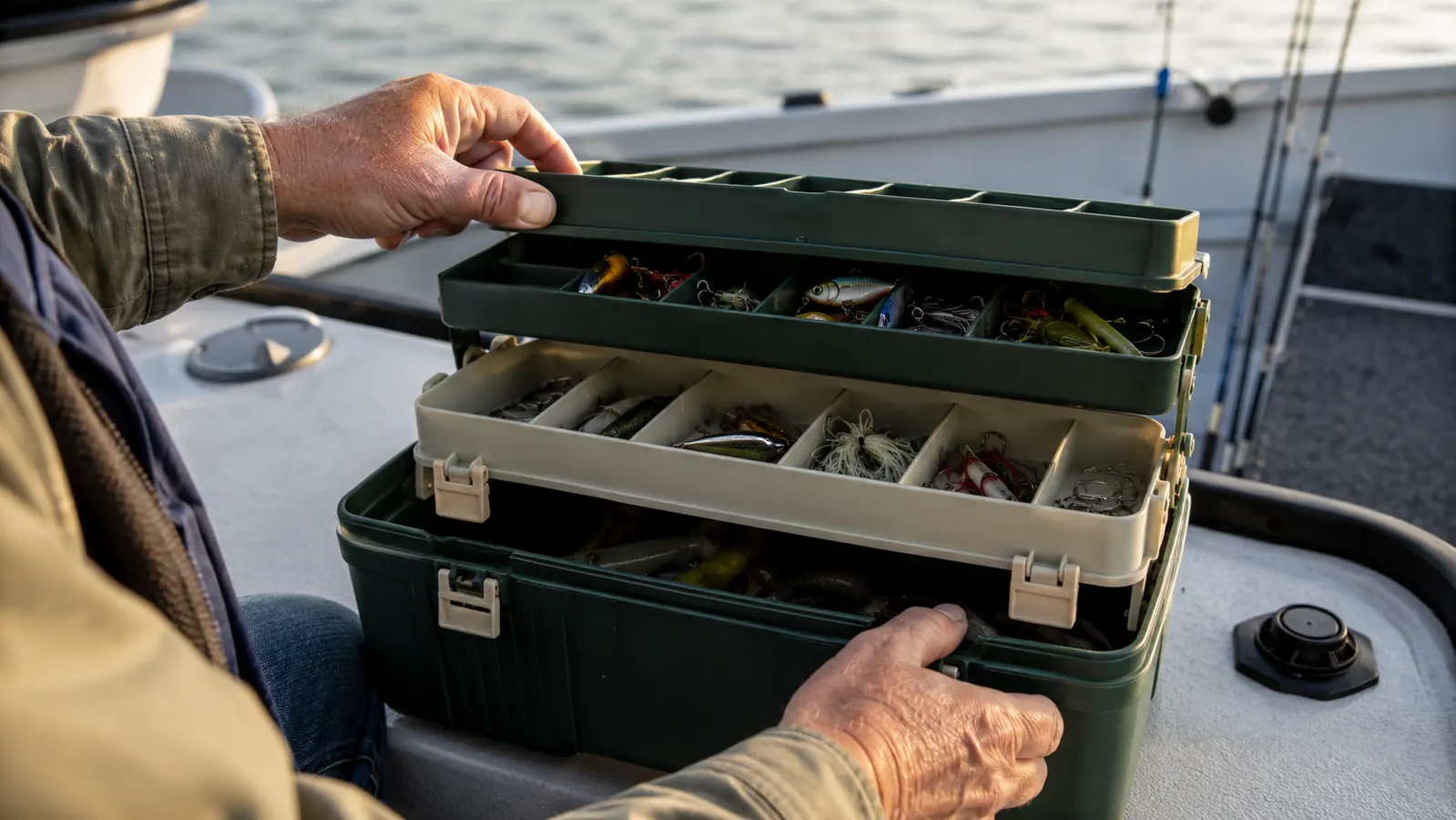
The whole point of this box is the layout, so let me walk you through it. You get three trays that pull out and sit on top of the box, and each one has its own set of compartments. I keep the top tray for the stuff I reach for first: a few Rooster Tails, a handful of jig heads, and the tube baits that catch smallmouth on the Current River when nothing else will. The middle tray holds the spinnerbaits and crankbaits that need room to lay flat. The bottom of the box is deep, and that deep storage is the part that sold me. That is where the soft plastic bags and the small boxes of hooks go, and it swallows them flat.
The top-access tray is the feature that sounds like marketing and actually works. You open the box and the top tray is right there, no digging. When I need a different tube color in a hurry, that top tray saves the thirty seconds that used to cost me the fish. The compartments are sized well, too. The little ones hold hooks and beads without letting them all pile into one corner, and the long ones take a spinnerbait without bending the blade.
The honest limit is the bottom of the box. It is one big open space with no dividers, so loose hooks and weights will roll together into one corner and take a while to sort out. I solved it with a couple of small plastic boxes inside the bottom, the kind that cost about a dollar each, and that turned the deep storage into something genuinely useful. If you dump a bag of hooks loose into it, you will be cursing it within a week. Put the small stuff in small boxes and it is close to perfect.
What I Keep in Each Tray
Since the whole point of a tackle box is what you put in it, here is exactly how I run mine. The top tray carries the daily drivers: a couple of Rooster Tails in the sizes that catch everything, jig heads from one-sixteenth to one-eighth ounce, and a bag of tube baits. That is the tray I open most, so it gets the stuff I would rather not hunt for. The middle tray holds the bigger moving baits, spinnerbaits and shallow crankbaits, plus a pack of extra hooks and a small spool of leader material.
The deep bottom is where the box earns its keep. Soft plastic bags go in flat, so the worms and craws do not get bent and twisted the way they do when you jam them into a flat tray. A couple of little boxes of weights and hooks sit on top. When I load up for a trip I grab the box, check the top two trays, and know in ten seconds whether I am set for the species I am after. That is the whole promise of a box like this.
The Latch and the Rust-Proof Claim
The latch is the thing I wanted to be skeptical about. The box is advertised with a rust-proof brass latch, and after a season of dew, river spray, and one afternoon when the whole box took a swim off the boat deck, I can say the claim holds. The latch still clicks clean and there is not a speck of rust on it. I have watched cheap metal latches on other boxes turn to crust by mid-summer. This one looks the same as the day I bought it.
The one honest gripe is that the latch wants two hands when your hands are wet and fish-slimy. It is a positive latch, which is exactly what you want for a box that rides in a truck bed, but it is stiff enough that I have fumbled it open a few times with a fish flopping on the deck. You get used to it, and it is a fair trade for a latch that never opens on its own. A latch that pops open in a truck bed ruins a tackle box, because it spills every tray at once.
How It Held Up Over the Season
Let me give you the wear honestly, because that is what a long-term review is for. The trays still slide in and out clean, the compartments have not cracked, and the latch is as good as day one. The plastic has scuffed up from bouncing around, and the corners have a few white marks where it smacked the truck bed. It looks like a box that has been fishing, which is what it is. If you want a box that stays pretty, leave it in the garage.
The things that usually kill a box in my experience are a broken latch, a cracked tray, or a hinge that gives up. None of those have happened here. The trays seat firmly, and as long as I close the top tray level, everything settles the right way. The one quirk is the level-seating thing: if you close the top tray crooked, it can dump the small compartments when you pick the box up. I have done it twice and scattered a dozen jig heads across the boat deck. It is a habit you learn in a week, not a design flaw, but I want you to know it is there.
After a season of dew, river spray, and a truck bed full of camping gear, that brass latch still clicks clean. A tackle box you stop thinking about is a tackle box doing its job.
The Made in the USA Detail
One thing that matters to me more than I expected is that this box is made in the USA. That is getting rare in fishing gear, and it shows in the little things. The plastic is thick and consistent, the hinges are molded into the body instead of glued on, and the whole thing feels like it was built by people who have actually carried a tackle box down a riverbank. You can feel the difference between this and a box that was made down to a price. It is the kind of thing you only notice after a season of use.
Alternatives I Considered
I thought hard about whether this was the right box to recommend. The obvious comparison is the Flambeau Stowaway, which has a similar layout and a good reputation. But the Stowaway's latch and tray locks have never felt as solid to me, and the Plano gives you the same three-tray setup without the markup. If you already own a Stowaway and it works, keep it. If you are starting from a pile of ziploc bags, the Plano is the easier call.
The other route is a soft-sided tackle bag, which is what I used to think I wanted. Bags are easier to carry and hold more, but they do not protect your hooks the way a hard box does, and they do not sit stable on a boat deck. A bag is the right answer for an angler who needs a hundred lures organized by binder. For the trips I actually take, where I grab one box and go, the hard three-tray is the better tool. It survives the truck bed, it stacks under camping gear, and it never lets a hook work its way through the side of a bag.
The box it actually replaced is worth naming, because it is the box so many of you probably have right now. Mine was a cheap flat tray with a flimsy handle and one big compartment, and it had one job: hold everything while I dug through it. It dumped its load every time I set it down on a slope. If that is what you are fishing out of, this box is an easy upgrade. It is the difference between fishing and shopping for your own tackle.
What I Liked
- Three trays with well-sized compartments that hold a full season of tackle
- Rust-proof brass latch that still clicks clean after a wet, muddy season
- Deep bottom storage that takes soft plastic bags and hook boxes flat
- Made in the USA with thick plastic and molded hinges
- Cheap enough to own one for the boat and one for the truck
Where It Falls Short
- Latch is stiff when your hands are wet and slimy, wants two hands
- Top tray dumps its small compartments if you close it crooked
- No dividers in the deep bottom, so loose hooks roll together
- Plastic scuffs and shows the bumps, purely cosmetic
Who This Is For
This box is for the angler who wants to grab one thing and go fishing. It is for the bank fisherman who walks a river with a rod in one hand and this box in the other. It is for the boat guy who wants a box that stays put on the deck and keeps the soft plastics out of the sun. And it is for anyone staring at a pile of ziploc bags who is tired of the dig. If you fish a few species through the year, the way I fish smallmouth, crappie, and catfish, this box holds the whole rotation in one place.
Who Should Skip It
If you are a tournament angler who carries four hundred lures and a binder system, this is not your box. You need the modularity of a bag and a stack of 3700 boxes, and the three-tray layout will feel limiting fast. And if you only fish one species with a couple of lures, a cheaper single-tray box is enough. But if your tackle looks anything like mine did last spring, a tangle of good intentions in a bucket, this is the box that fixed it.
After a season of bumps, this is the box that rides in my truck
The Plano three-tray tackle box is not the fanciest storage you can buy. It is the one that held up all season and ended the dig. Check today's price on Amazon.
Amazon Check Today's Price on Amazon →