
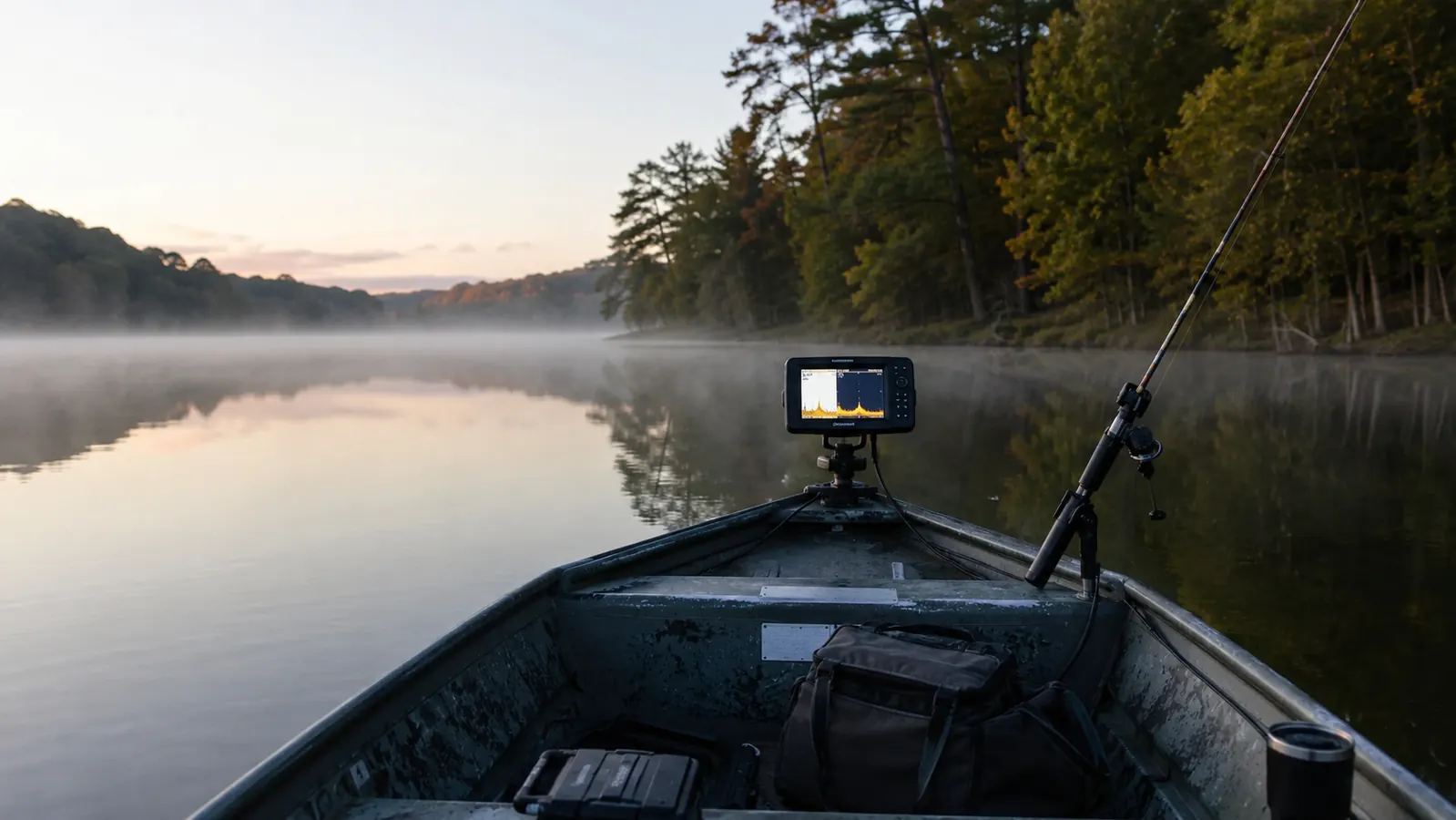
If you have typed "budget fish finder" into a search bar in the last year, you have stared at the same two boxes I stared at: the Garmin Striker 4 and the Humminbird PiranhaMAX. They sit side by side on the shelf, both about the size of a paperback, and the choice comes down to something real rather than a spec sheet. I got to make that decision the hard way. I ran the Humminbird for a season first, then added the Garmin and ran both on the same 16-foot jon boat through a full year of river and lake fishing. This is the comparison I wish I had read before I bought either one.
Here is the short version. The Garmin Striker 4 is the one that stayed on my bow. The built-in GPS lets me mark brush piles, humps, and creek channels and come back to them for weeks, and the CHIRP sonar gives me a cleaner picture in the timber where the Current River smallmouth live. The Humminbird PiranhaMAX has a slightly bigger screen, a genuinely simpler interface, and usually a lower price, and for a whole group of anglers that is the right trade. Let me show you where each one wins, because it is not as close as the spec sheets make it look.
When I judge a fish finder, I ask three questions. Does it show me fish clearly in the water I actually fish? Can it remember a good spot and get me back to it? And will I use the menus, or will I fight them every trip? Those three questions are where the Striker 4 and the PiranhaMAX separate. Everything else is a spec sheet.
Both units sat on the bow of the same jon boat, each with its stock transducer clamped to the transom. I fished them on the Current River for smallmouth, on Table Rock in March for crappie around brush piles, and on a couple of jugline nights on the lake for catfish. That mix of moving water, standing timber, and open lake is exactly where the two units start to show their differences, and I took notes after every trip.
The installation was a fair fight. Each unit comes with a gimbal bracket, and the transducer clamps onto the transom with the same style of mount, so moving either one between boats is a ten-minute job. I ran both off the same small 12-volt battery in my jon boat, and neither one drew enough power to worry about. If you can handle a screwdriver, you can have either unit mounted before your coffee goes cold.
| Garmin Striker 4 | Humminbird PiranhaMAX | |
|---|---|---|
| Price | Budget-priced for a color fish finder with GPS and CHIRP. Check today's price. | Usually the cheaper entry point of the two on the shelf. |
| Sonar | CHIRP sonar with cleaner arches and better target separation in wood and rock. | Standard dual-beam that shows depth and fish but gets noisier around brush. |
| GPS | Built-in GPS with waypoint marking and a breadcrumb trail back to your spots. | No GPS on the base unit. You mark spots with landmarks and a good memory. |
| Screen | 3.5-inch color display, crisp and readable in full sun. | 4-inch color display, a bit bigger and easier to read at a glance. |
| Ease of use | More menus and settings. Takes an evening to learn your way around. | Turn it on and it works. About as simple as a fish finder gets. |
| Mount | Comes with a gimbal bracket and moves between boats in minutes. | Same standard universal mount, also moves between boats in minutes. |
| Best for | Anglers who want to mark spots, run waypoints, and read cleaner sonar. | First-timers and bank anglers who just want depth and fish on the screen. |
Where Garmin Wins
The biggest reason the Garmin Striker 4 stayed on my boat comes down to one word: waypoints. When I found a crappie brush pile on Table Rock last March, I saved the spot on the screen and named it. Two weeks later I ran back across the lake in a fog so thick I could not see the bank, and the little dot on the screen put me within a cast of the pile. You cannot save a spot on a base PiranhaMAX, because it has no GPS at all. For anyone who fishes the same lake or river more than once, that one feature is the difference between the two units.
The trip that sold me was early last April on Table Rock. A cold front had pushed the crappie tight to the bottom, and the fish had gone quiet on every point I tried. I pulled up the waypoints I had saved in March, worked each brush pile slow with a jig, and put three keepers in the livewell off the second pile. Without the waypoints I would have spent the morning guessing and gone home empty. That is not a feature you use once in a while. It is the difference between an empty livewell and dinner.
The other place that GPS earns its keep is at night, on the jugline trips I run on the lake in July. The blue cats hold along an old creek channel that disappears once the water comes up, and the Striker 4 lets me idle that channel edge and drop each jug where the bottom rolls from twelve to eighteen feet. I saved that stretch as a waypoint the week before, and it put me back on the drop-off in the dark when the bank was nothing but a black wall. Without it I would have spent the night moving jugs that never got a bump. That is the kind of win you cannot see on a spec sheet.
The sonar is the second reason, and it shows up the moment you drop the trolling motor. The Striker 4 uses CHIRP, which sweeps a range of frequencies and builds a much cleaner picture than a single-frequency ping. On the Current River, where smallmouth sit tight against laydowns and rock ledges, I can pick a fish holding on the bottom away from the branch it is hugging. The PiranhaMAX shows me the same water but with more clutter, and in heavy timber that clutter is exactly where the fish disappear. Cleaner is not a luxury on a river like that. It is how you find the fish at all.
The CHIRP sonar also holds up when the water gets shallow. I fish a lot of water under ten feet, and that is where cheap single-frequency units get mushy. The Striker 4 keeps a sharp bottom line even over two feet of river rock, so I can idle a gravel bar and read the drop-off instead of guessing. The PiranhaMAX is not bad here, but it is softer on the edges, and in shallow water those soft edges are exactly where the fish hide.
There is a third Garmin win that does not get talked about enough, and it is the breadcrumb trail. The Striker 4 draws the path you have traveled on the screen, so when I am working a long gravel bar or following a creek channel, I can see where I have been and where I have not. On a river with current, that keeps me from wasting a drift over water I already covered. It sounds like a small thing until you have spent an afternoon wondering whether you fished that stretch yet.
Where Humminbird Wins
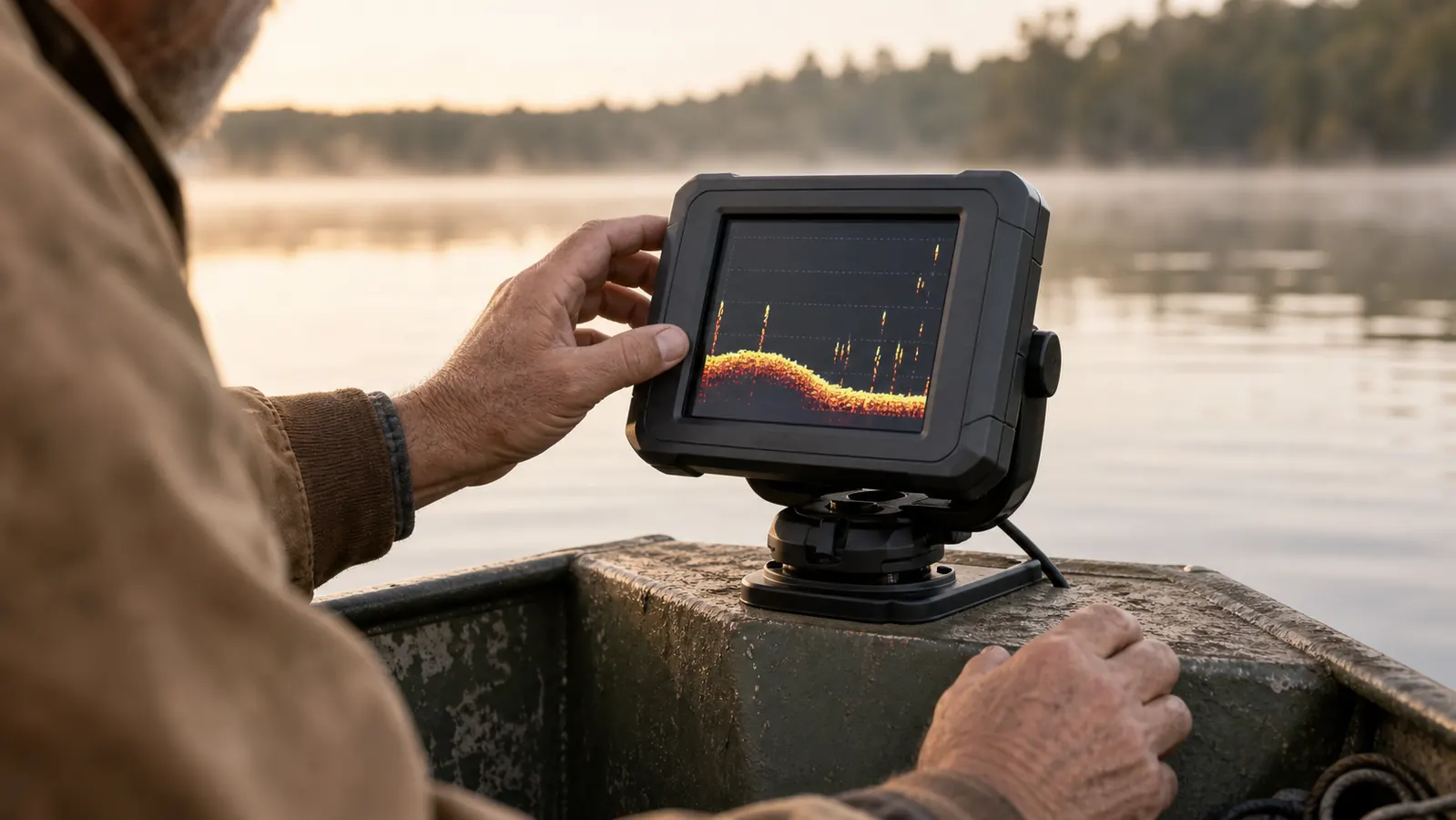
I am not going to pretend the PiranhaMAX does not have its day, because it does, and for some anglers it is the better buy. The first thing you notice is the screen. It is a 4-inch display against the Garmin's 3.5 inches, and while that does not sound like much on paper, it reads easier when you are bouncing across a chop and stealing a glance down. The extra half inch is the difference between seeing the depth at a glance and squinting for it.
The PiranhaMAX also wins on simplicity, and I mean that as a real compliment. There is basically one menu button and a short list of settings. A person who has never owned a fish finder can mount it, turn it on, and have depth and fish on the screen in the time it takes me to find the right menu on the Garmin. If you want a unit that just works and never asks anything of you, that is worth more than any feature list.
Here is the day the simplicity won. My nephew came up in June and I put him on the PiranhaMAX in the front of the boat. He had never touched a fish finder in his life, and inside ten minutes he was calling the depth off the big numbers and hollering about fish arches like he had been doing it for years. On the Garmin I would have spent the first hour walking him through the menus before he ever saw a fish. There is real value in a unit that does not make a beginner feel dumb on the water, and I will not take that away from the Humminbird.
Give the PiranhaMAX credit for being a tough little unit too. Mine rode in a rod locker for a season before I handed it to a friend for his boat, and it took the bumps without a hiccup. For the money, the dual-beam sonar is honest: it shows depth, bottom hardness, and fish arches well enough to put a bank angler onto crappie. It is not the cleaner picture of the Garmin, but it is a real fish finder, not a toy.
Then there is the price, which is usually the friendlier of the two when you check today's prices on Amazon. For a bank angler, a kid's first boat, or someone who mainly wants to know how deep the water is and whether fish are under the boat, the PiranhaMAX is an honest little unit and I would not talk anyone out of it. It just does less, and the biggest thing it does not do is remember where the fish were.
Mark the spot. Come back to it.
If you fish the same lake or river week after week, the waypoint marking on the Garmin Striker 4 pays for itself the first time you run straight back to a brush pile you saved in the fog.
Amazon Check Today's Price on Amazon →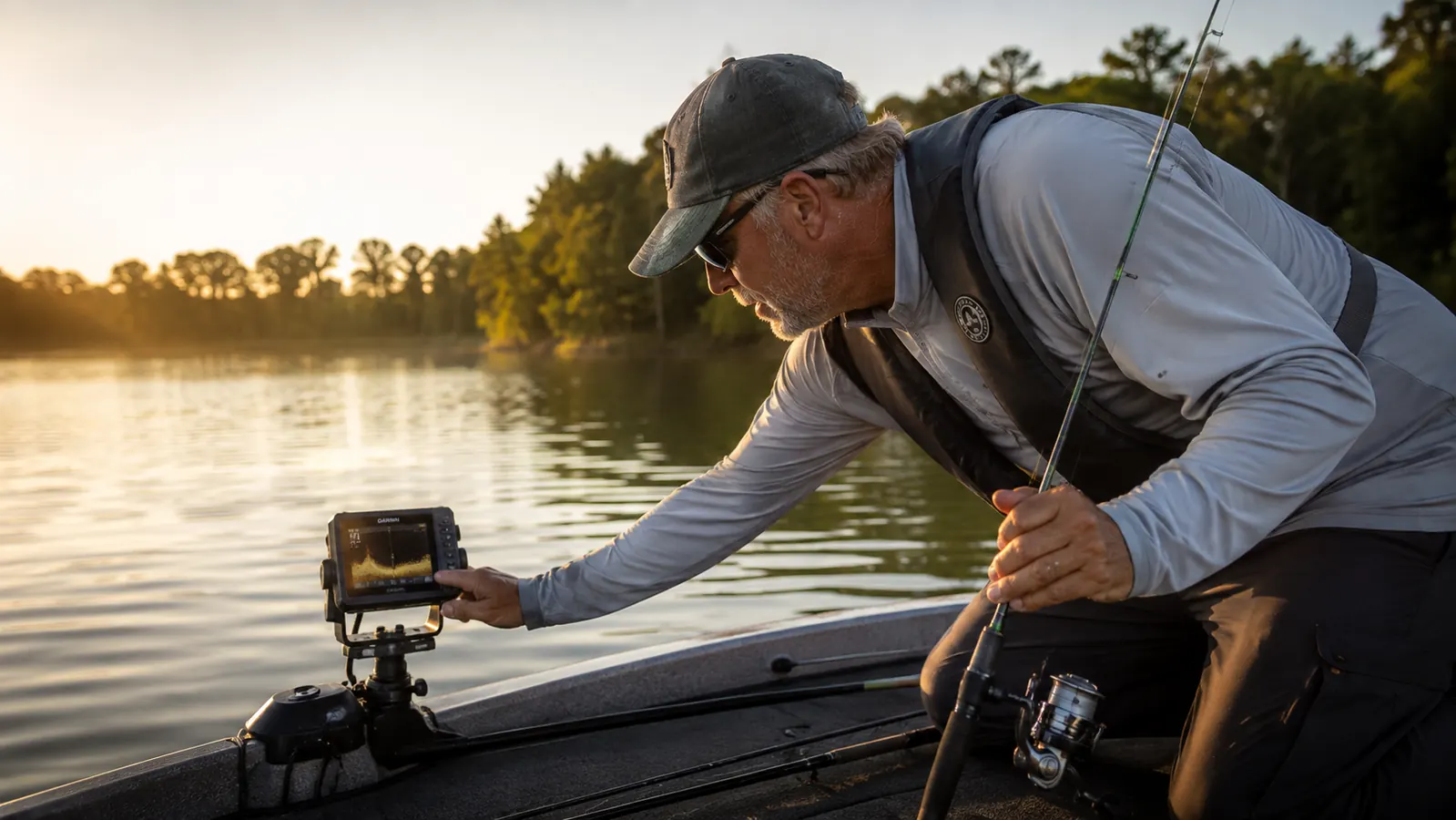
Who Should Buy Which
Buy the Garmin Striker 4 if you fish water you plan to fish again, which is almost everyone with a boat. The waypoints turn a day of scouting into a map you keep, and the cleaner CHIRP picture helps on any water with wood, rock, or current. I marked my first brush pile on Table Rock in March and I am still fishing it in September. That is the whole pitch, right there.
If you spend most of your time on a river like I do, the waypoints and the cleaner sonar are not luxuries. The Current River changes with every rain, and a brush pile that held fish in June can be gone by July. When it is still there, the Striker 4 lets you find it again instead of re-learning the river on every trip. That is worth the difference in price to me, and I would spend it again.
Buy the Humminbird PiranhaMAX if you want the cheapest honest unit that shows depth and fish, if you fish from the bank or a dock where waypoints do not matter, or if you want something simple enough that you never have to crack the manual. It is not a worse fish finder. It is a simpler one. The only mistake you can make is buying the wrong one for the way you actually fish.
The way I put it to my fishing buddies is this: the PiranhaMAX tells you what is under the boat right now. The Striker 4 tells you what was under the boat last month, and it helps you get back there. If you fish the same water more than once, that memory is worth carrying on the bow. Both units are a real step up from staring at a bare depth sounder, and I would buy the Garmin again tomorrow without hesitating.
The one I kept on the bow.
After a season with both units on the same boat, the Garmin Striker 4 is the one that stayed. If your trips are anything like mine, you will mark your first waypoint in the first hour on the water.
Amazon Check Today's Price on Amazon →