
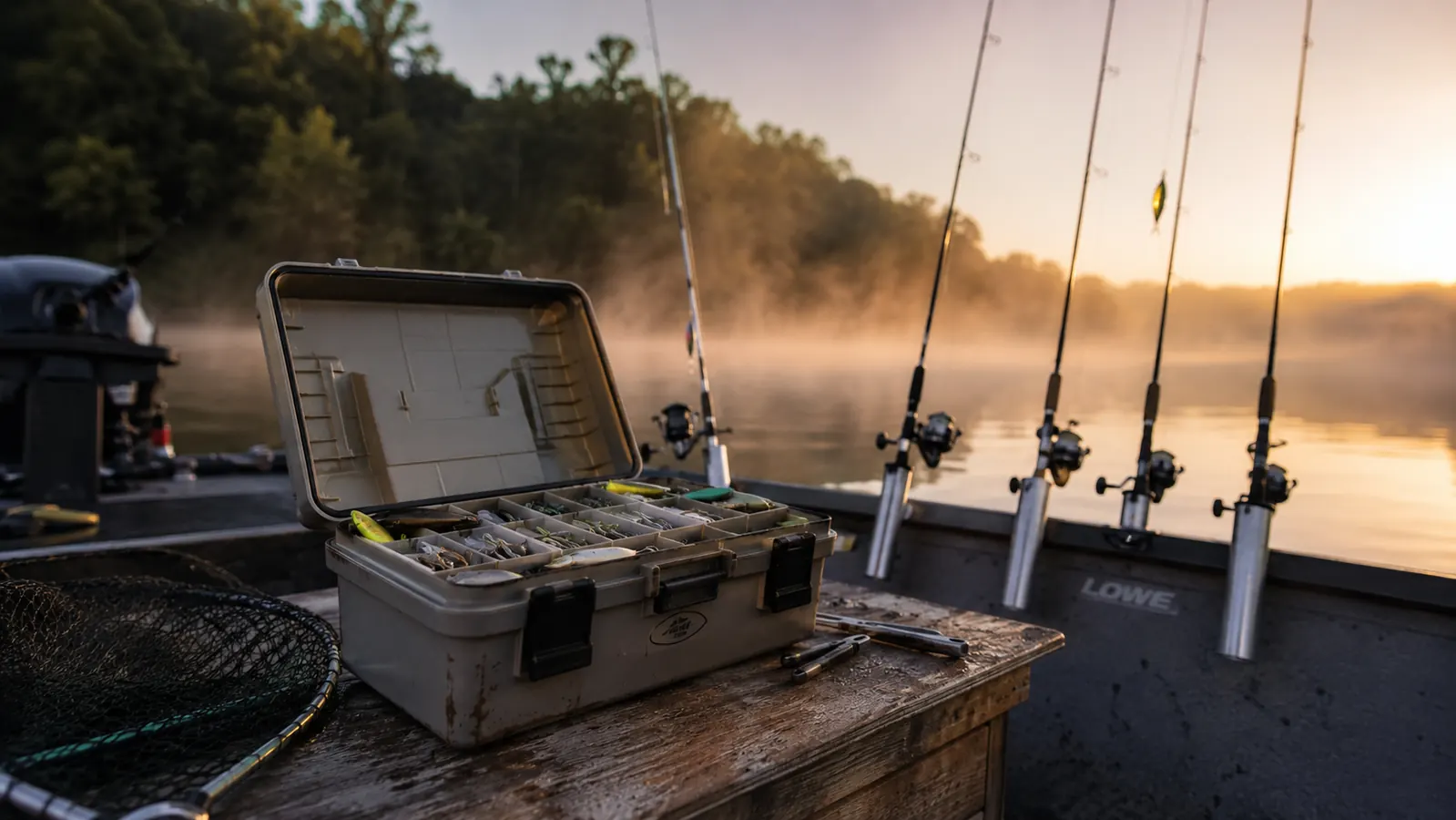
Every tackle box I owned before this one died the same way. The latch snapped off on a rock or a tailgate, the tray dumped when I tipped the box, and I would spend the best part of a bite digging through a pile of jigs and hooks in the bottom of a cooler while smallmouth busted shad twenty feet off the bank. I went through three cheap boxes in two seasons before a friend who guides on the White River told me to quit the bargain rack and buy a Plano. He was right, and a year later I am still on the same box. But that year taught me some things the product page does not put in the bullet points, and this review is the honest version of that story.
This is the honest version of the review, the one where nothing gets five stars just for showing up. I bought the Plano three-tray in early March, loaded it with crappie rigs the same night, and ran it through a full year of fishing. It did the crappie run, a summer of juglining for flatheads, a fall of smallmouth on the river, and a handful of winter trips for anything that would bite. Along the way it got thrown in a truck bed, bounced down a gravel road in the four-wheeler box, sat on a boat deck in July sun, and got rained on more times than I can count. That is the test that matters, and here is what the box did.
The Quick Verdict
A box that actually survives being fished hard. The rust-proof latch claim held up, the tray layout keeps the lures you reach for on top, and it is honest about its limits: three trays is not a moving van for a tournament arsenal.
Amazon Check Today's Price →The Box That Survived a Year in My Truck Bed
If you are tired of replacing a box every time a latch busts, this is the one I grab first. It has earned its spot in my truck, and it will earn its spot in yours.
Amazon Check Today's Price on Amazon →How I've Used It
I did not test this box from a kitchen table. I bought it on a Thursday, loaded it the same night, and it has lived in the truck ever since. The first test was the worst one. I had it in the bed of my pickup with a cooler and a crate of juglines, took the river road a little fast, and the box hit the tailgate, bounced, and landed on gravel. Not a single tray popped, and the latch did not even skip. That first drop told me more than any spec sheet could, because the spec sheet does not tell you how the latch holds when the whole box leaves the truck bed.
Since then it has made every trip I have made in a year. A dozen crappie mornings in March and April, jugline nights in July when it sat on the bank by the fire, and smallmouth days wading the river with the box riding the four-wheeler over rocks. I have dropped it, sat on it, spilled coffee on it, and one night I left it out in a hard rain because I was too tired to carry it in. The honest part is that it is not indestructible, nothing plastic is, but after a year the parts that normally break on a box are still working. That is the whole review in one sentence.
I kept a running mental list of every failure I expected and every one that actually happened. The latch did not pop. The trays did not dump. The brass did not corrode. The plastic did not crack. The things that did happen, the scuffs and one stress mark, were cosmetic and cheap. When a box fails in exactly the ways you predicted, that is a box you can plan your season around.
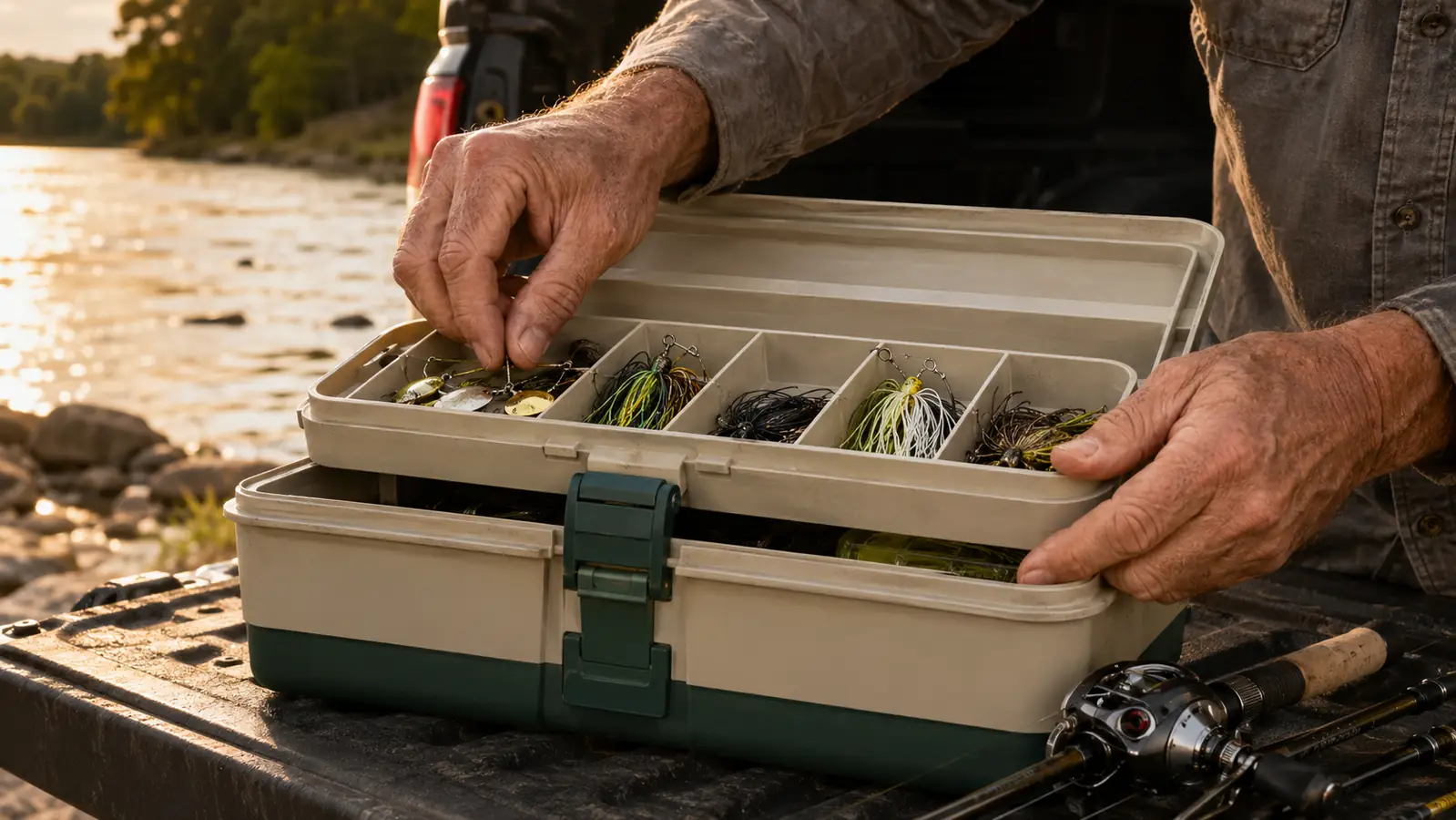
The Latch That Earned Its Keep
The thing that sold me was the latch, and a year in, it is still the thing I trust. The product page calls it a rust-proof brass latch, and after a summer of rain and a winter in a damp truck, it looks the way it did the day I bought it. No corrosion, no green crust on the brass, no sticking when the morning dew is on it. I have owned boxes where the metal clasp rusted so bad the latch would not close, and you do not get that here. The brass is the detail you cannot see in the product photos, and it is the one that decides whether the box survives the second season.
The latch is also the part that actually keeps the box shut. Cheap boxes use a clasp that hooks over a lip, and the first time the box gets bounced, the clasp pops loose and the tray goes everywhere. This one clicks over solid, and it takes a real pull to open it. Two hands, thumb on the release, and it pops. My only complaint is small: it takes practice to open one-handed while you are holding a rod. After a month you do it without thinking, but the first few trips I had to set the rod down and use both hands.
The other thing about the latch is the way it sits in the box. It does not stick out where a cooler or a dog crate can catch it and shear it off. On my old boxes the clasp was the highest point, so it was the first thing to hit the ground. Here the latch sits low enough that the plastic takes the hit first and the brass stays out of the way. That little design choice is probably why the latch still works.
Three Trays, and the System That Sticks
The layout is three trays, and the way they stack is the reason I stopped digging. The top tray is the one you see first, and that is where the everyday stuff goes: the spinnerbaits and the jigs I reach for on every cast. It is a shallow tray with dividers that are actually long enough to keep the compartments from mixing. That sounds small until you have owned a tray where a #4 hook migrates into the worm compartment overnight and you stab yourself on the first cast of the morning.
To give you a picture of the load, tray one holds eight spinnerbaits, a dozen crappie jigs, and a few small crankbaits I use for river smallmouth. The deep tray holds the bigger jig heads, the heavier spinnerbaits, and the lipless cranks I only throw when the water is high. The bottom tray is where the maintenance stuff lives: a spool of 6-pound mono, a packet of swivels, a few packs of hooks, and the bottle of scent I use on soft plastics. That is a whole season of fishing for three species, and it all closes flat.
One thing nobody tells you: the trays do not come out for cleaning the way the old ones did. The dividers are fixed, which keeps the compartments honest but makes a deep clean a little fiddly. You can work a damp rag in there, but you are not popping the tray out and hosing it down like an old bait box. It is the tradeoff for the stiffness, and I will take it, because a tray that stays put is worth more to me than a tray I can scrub in the sink.
A Year of Bounces
Here is what a year of being treated like fishing gear actually did. The plastic is thick enough that it has not cracked, and I have dropped it on gravel more than once. The lid still sits flat, the trays still slide smooth, and the latch still clicks. The white parts have picked up scuffs from the truck bed, but the box has not warped in the sun. I have left it in a closed truck on a July afternoon, and the trays still open and close like they did in March. Heat is the thing that kills cheap plastic, and this box did not let the heat win.
The wear is not nothing. The corners are scuffed down to the base plastic, and one of the tray handles has a hairline stress mark where a cooler landed on it. Nothing is broken, but it is a working box now, not a showroom piece. If you are the kind of person who keeps gear looking new, this box will not do that for you. It takes its licks, and it shows them in the scuffs, not in the function. I would rather have a box that looks beat and works than one that looks new and dumps.
The rust-proof claim is the one I was most skeptical about, and it is the one that held up best. The brass has not corroded after a year of river water and morning dew. That is a claim nobody in the cheap rack is making, and it is the reason this box outlives the ones that cost half as much. Plano has been building boxes for a long time, and this is the part of the build that shows it.
Where It Falls Short
I will be straight about the parts that are not perfect. First, three trays is three trays. If you carry a serious multi-species arsenal, this box is not your whole answer. It is a great box for the lures you actually use, not a moving van for everything you own. I run this one plus a small soft pouch for wading days, and that combination is what works for me. If I needed one box to hold everything, I would be reaching for a bag system instead.
Second is the one-handed opening. When the fish are biting, you want to pop the box, grab a bait, and get back to casting. This latch is stiff enough that you need the box on a flat surface and both hands the first few times. It loosens up, but it is not a quick-open box like some of the soft-sided pouches. That is the honest tradeoff for a latch that does not pop open on a bounce. You trade a little speed at the box for a lot of reliability everywhere else.
Third, it is heavier than it looks once you load it. A box full of hooks and cranks is no feather, and the thick plastic adds its own weight. If you are hiking into a river, you will feel it on your shoulder. For truck and boat fishing, that weight buys you the toughness. For a long walk, look at a soft pouch instead.
Alternatives I Considered
Before I settled on this one, I looked hard at the Flambeau Stowaway, the other box with a loyal following. It is a good box, and when I ran them side by side for a season it beat the Plano in a couple of spots, mainly in how quickly the trays come out for cleaning. But for the way I fish, the Plano's deep storage and the latch won. I wrote the full comparison if you are trying to decide between the two, because the answer really depends on what you carry and how you treat your gear.
I also considered just buying another cheap box and rolling the dice, the way I had for years. That was the false economy that got me here. A box that busts its latch in a season costs less up front and more over a year, and it costs you fishing time when the tray dumps in the bottom of the truck. The Plano is not the cheapest box on the shelf. It is the cheapest box I have owned, if you count it by the season it lasts.
What I Liked
- Rust-proof brass latch that still works after a year of rain and dew
- Deep storage tray holds crankbaits and jig heads without tangling treble hooks
- Thick plastic takes drops and gravel without cracking
- Dividers are long enough to keep compartments from mixing
- Made in the USA
Where It Falls Short
- Stiff latch takes two hands at first, not a quick-open box
- Fixed dividers make a deep clean fiddly
- Scuffs show on the white parts after hard use
- Three trays will not hold a tournament arsenal
A year of river water and July truck beds, and the brass latch still looks like the day I bought it. That is the claim nobody in the cheap rack is making.
Who This Is For
This box is for the angler who is tired of buying the bargain rack and watching a latch die midseason. It is for the bank fisherman, the wading smallmouth guy, the crappie angler who wants his jigs organized, and the jugliner who needs a box that can sit on a gravel bank by a campfire and still close in the morning. If you fish a few days a week through the season and you want a box you stop thinking about, this is that box. It is not fancy, it is not light, and it does not need to be.
Who Should Skip It
Skip it if you need to haul everything you own. If you are running a hundred lures and eight rods out of one box, you want a bag system or a bigger box. Skip it if you hate any scuff on your gear, because this box takes its licks and shows them. And if you need a box that opens one-handed mid-bite with a rod in the other hand, the stiff latch will frustrate you in the first month. Those are the honest reasons to pass, and there is no shame in any of them.
Still the Box I Grab First
After a year of abuse, this Plano three-tray is the box that earns its spot in my truck. If yours keeps busting a latch every season, check today's price on Amazon and stop replacing boxes.
Amazon Check Today's Price on Amazon →