

The honest review of a fish finder starts the way most fishing trips do: with a guy staring at a screen and having no idea what he is looking at. That was me the first morning I powered up a Garmin Striker 4 on the Current River. I had spent the whole winter reading reviews that said the sonar was clear and the GPS was simple, and none of them mentioned that the first time you switch it on, every mark on the screen looks like a fish and none of them are. Two seasons later I know what I am looking at, I have caught more fish because of it, and I have a short list of things that annoy me about it. This is that list, and the good stuff too.
I am going to tell you right up front that I like this unit, because if I do not say it now you will read the glitches below and think I am trying to talk you out of it. I am not. The Striker 4 is the best budget fish finder I have owned, and it is still bolted to my boat. But every review of this thing reads like it was written by somebody who ran it for one weekend and mailed it back. Two seasons of real use gives you a different story, and the honest parts are the ones the marketing does not print.
The Quick Verdict
The Garmin Striker 4 earns its spot on my bow, but the small screen and the numbered waypoints will test your patience before you learn to work around them. The sonar and GPS are the best value in the class, and the glitches are workable, not dealbreakers.
Amazon Check Today's Price →The fish finder that shows you what you have been missing
Two seasons on the Current River and Table Rock Lake taught me exactly what the Garmin Striker 4 does well and where it grinds on you. If you fish a small boat and want to stop guessing, check today's price on Amazon before you read the next five-star review.
Amazon Check Today's Price on Amazon →How I've Used It
My Striker 4 has spent two seasons on the bow of my 16-foot aluminum boat, and it has also made a couple of trips on the floorboard of a friend's johnboat when I loaned it out. That is the first thing you should know: it is light and compact enough to move between boats in five minutes, which is something the big screens cannot do. I fish the Current for smallmouth, Table Rock for crappie in April, and the river again for catfish on summer nights.
I am not going to pretend I set it up with any skill. The transducer went on the transom with the clamp that came in the box, the cable ran up the side of the boat with zip ties, and the whole thing took me an afternoon because I routed the cable wrong the first time and did it again. The manual shows a clean install under the hull. Mine is not that. It has worked anyway, which tells you the unit is more forgiving than I am.
Most trips I leave it on the traditional sonar view and only touch the buttons to drop a waypoint. I fish a lot of slow water, so I do not need much. When I do switch to Chirp, the difference on the screen is obvious, but I will get to that. The point here is that you do not have to be a menu person to get value out of it, and I am the proof.
What the Sonar Shows You (and What It Does Not)
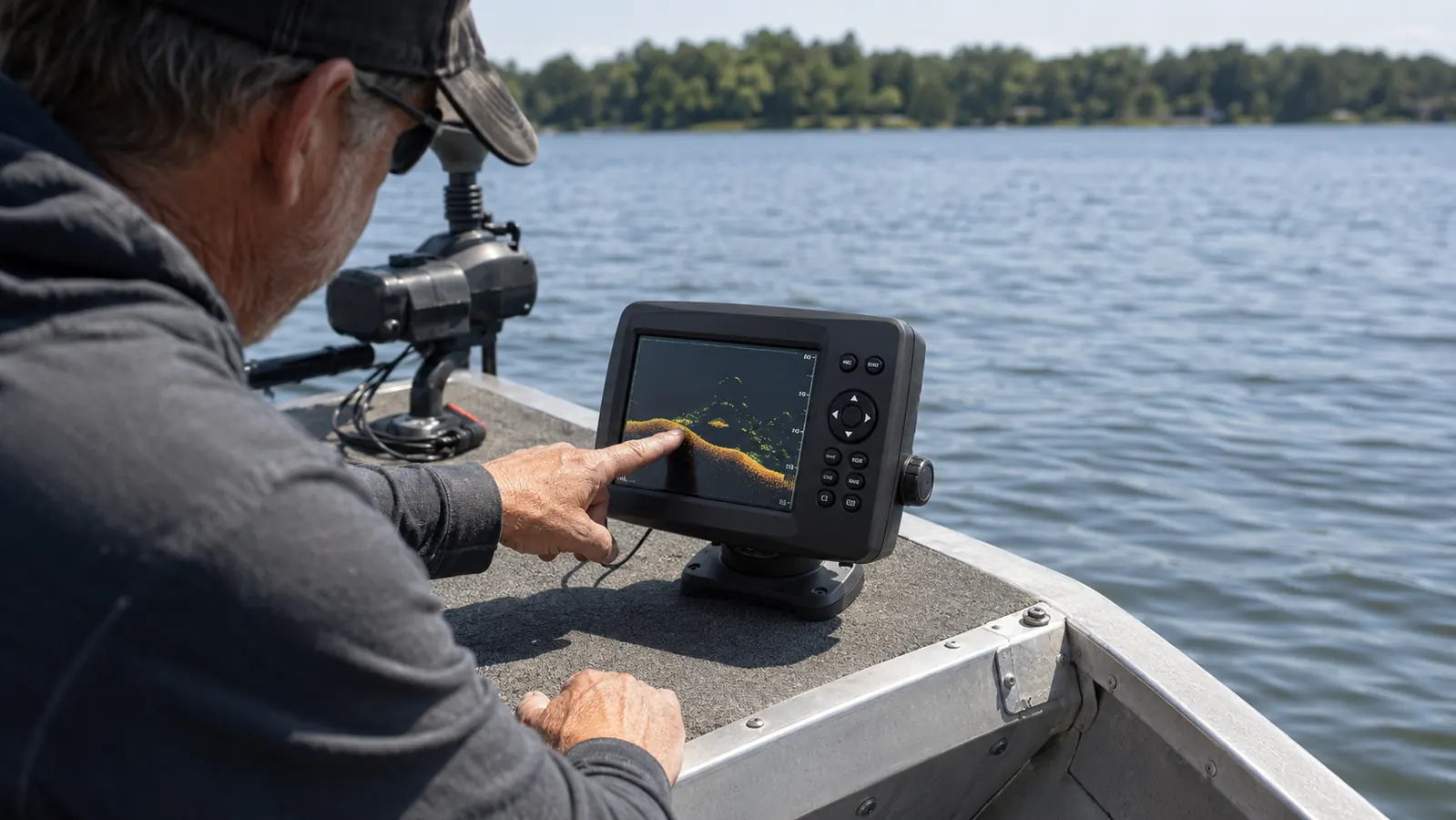
The sonar is the reason people buy this unit, and it is good. On the Current, in eight to twelve feet of clear water, it draws the bottom as a clean band and shows a brush pile as a cluster of marks that sit off the bottom like a little tree. Chirp makes that cluster sharper, and it separates two fish that are close together better than the old single-beam units I grew up with. For the money, I have not seen it beaten.
But here is what nobody tells you in the reviews: it takes a while to believe what you are seeing. My first three trips, I marked every blob and called it a fish, and I burned a lot of casts on water that was empty. A fish holding on the bottom shows as a mark that stays at one depth, not a blob that rises and falls. Bait shows as a cloud mid-water. You learn it, but you learn it on the water, not from the manual, which is basically useless.
The other thing nobody tells you is that this is a slow-water tool. At plane speed the bottom blurs and then disappears, because the transducer reads a cone under the boat and you are outrunning it. I do not graph bottom while running, so it does not bother me. If you spend your day running across open water at speed and watching the screen, you will be disappointed, and you should buy something bigger.
One setting note, since it took me a season to find it. The depth range on auto works most of the time, but in really shallow water it can chase itself and clutter the screen. I set the range manually when I am on the river, and the display settles right down. It is a small thing, but it is the kind of small thing that makes a unit feel like it belongs to you.
The GPS Nobody Mentions in the Reviews
The GPS is the feature I would not give back, and it is also the one that gets oversold. The Striker 4 does not come with maps. There is no lake contour, no depth chart, no navigation screen with a boat arrow moving over a chart. What it does is drop a waypoint at your current spot and draw a track line of where you have been. That is the whole GPS, and it is enough.
On Table Rock, where the shoreline all looks alike and the crappie move onto specific points in April, I have a collection of waypoints that is my own private chart. I found a point that held fish on a slow day, saved it, and came back to it three weekends in a row. Without the waypoint I would have been guessing at a spot that looked like every other point on the lake.
Now the part that grinds. When you save a waypoint, the unit names it something like WP 0147. There is a way to rename it, but it involves paging through menus on a 3.5-inch screen, and I gave up after the first season. I keep a spiral notebook in the tackle box that says what WP 0147 is and where it sits. It is clunky, and it is the kind of thing you will not read about in a sponsored review.
One more honest note about the GPS. It needs a clear view of the sky. Under a canopy of trees in a narrow river hollow, it can take a couple of minutes to figure out where it is, and there have been mornings I idled out of the cove before the satellite icon stopped blinking. Out in the open it locks in fast. If you fish tight timber all day, know that the waypoint will not always be right where you dropped it.
How It Held Up Over Two Seasons
The unit itself has been a tank. Two seasons of river water, boat sun, and gravel roads, and the screen is scratch-free and the buttons still click. I have not babied it, and it has not complained. The transducer has grazed a couple of rocks on the Current and still reads clean, which tells me the mounting is doing its job more than the puck is.
It drinks almost nothing. I run it off the same little 12-volt battery that runs the trolling motor, and a full day on the water barely moves the charge. If you are on a kayak, a small sealed battery will run it for a weekend without blinking. That tiny draw is one of the reasons it can live on the bow all season instead of getting packed away after every trip.
It has been through hard rain and the kind of heat that makes the deck too hot to touch barefoot, and it has never once failed to power up. That is the part I did not expect at this price, and it is why I trust it for a week on the water and not just an afternoon. The electronics in a budget unit are supposed to be the compromise. In this one, they are not.

Where It Glitched on Me
The screen is the thing I complain about most, and I want to be specific about it. In full sun, with polarized sunglasses on, the 3.5-inch display goes dark at certain angles, and tilting the mount only fixes one axis. I end up leaning to one side to read it, which looks as ridiculous as it sounds. It is readable, but it is work, and on a bright July afternoon on open water I have cussed it more than once.
The numbered waypoints are the second thing, and they are the reason the GPS section above reads the way it does. You can rename them, but on this small screen with the arrow-pad menu, it is not worth the effort. My notebook works, and it has a bonus: when I forget it, I get to re-find the spot the hard way.
There was one afternoon on Table Rock when the unit froze. The screen went blank for maybe thirty seconds and then came back on its own with the depth reading wrong, and it took a power cycle to straighten it out. It has happened exactly once in two seasons. I am telling you because every electronics review that says a unit never glitched is not being honest with you, and I would rather you hear it from me than learn it on the water.
The Alternatives I Considered
The other name at this price is the Humminbird PiranhaMAX, and I looked at it hard. Some models give you a bigger screen for the same money, which is tempting. What pushed me to the Striker 4 was the GPS. The PiranhaMAX in this price range is a sonar first and a waypoint tool second, and the GPS is the half of this unit I use every single trip. I would rather have a smaller screen with the GPS than a bigger screen without it.
The next step up from the Striker 4 is a big one. Units with real maps, side imaging, and a screen you can read from the helm run two to three times the money, and for the way I fish, I would not use most of it. The honest math of this class is that the Striker 4 does the two jobs a weekend angler actually uses, and it skips the rest to hit the price.
If I were buying today, I would buy the same unit again. The screen is the only thing that tempts me to spend more, and I have not been able to justify it yet. When my eyes get old enough to need a bigger display, I will know exactly what to buy, and this unit is the reason I will know it. For now, the Striker 4 is still the best answer to the question it answers.
What I Liked
- Chirp sonar that paints a genuinely clear picture at slow speeds
- GPS waypoints and tracks, with no maps to buy and no subscription to feed
- Built like it costs twice as much, two seasons of abuse and it still works
- Tiny power draw, runs all day off a trolling motor battery
- Light enough to move between boats in minutes
Where It Falls Short
- The 3.5-inch screen washes out in full sun, especially with polarized glasses
- No maps at all, just a blank grid and numbered waypoints
- Loses the bottom at plane speed, it is a slow-water tool
- Waypoints come numbered, and renaming them on the unit is a chore
- Cable routing is on you, and a clean install takes an afternoon
The first time the screen showed me a channel swing I had been fishing past for a decade, I sat and stared at it like it was a television.
Who This Is For
Buy the Garmin Striker 4 if you fish from a small boat or a kayak, you are tired of guessing where the bottom is, and you do not want to spend a month of trips on a fish finder. It is for the angler who wants to see the bottom, mark the good spots, and come back to them next week. If that is you, this is the cheapest honest way in, and it will not hold you back.
It is also the right call if you are new to electronics and not sure you will use one. You can run a Striker 4 for a season, and if it turns out you never look at it, you are not out much. If it turns out you love it, you will know exactly which features you want in the bigger unit later, and the Striker 4 will have taught you that without wasting your money to do it.
Who Should Skip It
Skip it if you fish big open water and want the screen to show you depth contours and standing timber on a map, because the Striker 4 will not do that. You want a unit with built-in mapping, and that costs more. Skip it if your eyes need a bigger screen, because 3.5 inches is small, the glare is real, and neither one gets better with age.
And skip it if you spend most of your time running at speed and want to watch the bottom while you move. This is a slow-water tool, and I have been straight about that. For trolling, drifting, and working the trolling motor, it is hard to beat at the price. For those other jobs, it is the wrong tool, and I would rather tell you now than have you find it out on the water.
Fish the water you have been guessing at
Two seasons in, the Garmin Striker 4 still earns its spot on my bow. It has glitches, and I listed every one of them above, because that is the review I wanted before I bought mine. If you can live with a small screen and numbered waypoints, it is the best value in sonar I have used. Check today's price on Amazon.
Amazon Check Today's Price on Amazon →